Radiology Billing Services
ClaimCarePro provides radiology billing services that cover professional, technical and global component billing, modality coding from the signed report, contrast and supply lines, interventional radiology, imaging-center and IDTF claims, denial and underpayment work, and credentialing for radiologists and imaging sites. Full-service billing is 6% of collections with a $1,000/month minimum, month-to-month, no setup fee; aged and denied A/R is recovered on a 10% contingency.
What our radiology billing services include
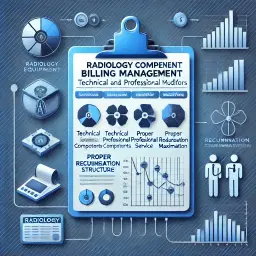
Professional, technical and global component billing
Every study billed for the half you actually own: modifier 26 for the interpretation and signed report, TC for the equipment and technologist, no modifier when one entity owns both. Before a split goes out, the code's PC/TC indicator on the Medicare Physician Fee Schedule is checked, because not every imaging code can be split. The modifier-by-modifier reference is in our radiology billing guide.
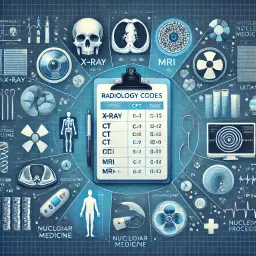
Modality coding from the signed report
X-ray, CT, MRI, ultrasound, mammography and tomosynthesis, DXA and nuclear medicine coded from what the radiologist read, not what was ordered. Views, laterality and contrast status are code selectors in most families, so the report language has to match the descriptor before the claim leaves.
Contrast, radiopharmaceutical and supply billing
In an office or freestanding center paid under the Physician Fee Schedule, contrast is reported on its own line with the HCPCS supply code for the agent and the units given, such as Q9965–Q9967 for low-osmolar iodinated contrast, per payer policy. In the hospital outpatient setting, Medicare packages contrast agents into the procedure payment (42 CFR 419.2(b)(15)), and a reading group billing modifier 26 never bills the contrast at all.

Hospital-based reading groups and teleradiology
Reading groups bill the professional component across every hospital, outpatient department and imaging center they cover. Each site's technical-component owner is mapped once, so a global claim never collides with the facility's TC claim. Medicare's place-of-service instructions for the two components are in the Claims Processing Manual, Pub. 100-04, Chapter 13, §150.
Interventional radiology claims
Embolization, venous and arterial interventions, biopsies, drains, ports and vertebral augmentation billed under the comprehensive codes CPT now uses: catheter placement, imaging guidance and completion imaging are inside the code. Diagnostic angiography in the same session is reported only when the report documents why it was a new diagnostic study, and NCCI modifier indicators are read before any 59 or X modifier is appended.
Imaging payment reductions applied correctly
Medicare's multiple procedure payment reduction cuts the technical component of the second and later imaging studies in the same session by 50% and the professional component by 5%. CT on equipment that does not meet the NEMA XR-29 dose standard carries modifier CT and a 15% TC reduction (CMS, since 2017); X-rays taken with computed radiography carry FY and a 10% TC reduction (Medicare MAC guidance, since 2023). We report the modifiers the equipment requires and check that each reduction was applied once; the rule table is in our radiology billing guide.
Imaging centers, IDTFs and in-office imaging
Independent diagnostic testing facilities bill under the 42 CFR 410.33 standards: every test needs a written order from the treating physician, a supervising physician may cover no more than three IDTF sites, and the facility carries at least $300,000 of liability coverage per location. Physician offices that buy an outside interpretation fall under the anti-markup rule (42 CFR 414.50). We keep the orders, the site enrollment and the billing aligned with both.
Radiologist and imaging-center credentialing
Medicare enrollment through PECOS, including IDTF enrollment and reassignment of each radiologist's benefits to the group, plus Medicaid and commercial network applications for every site the group reads for. A flat $250 per payer application, a $1,750 new-practice bundle per provider, and $99 a year for maintenance.
Why radiology claims deny — and how we prevent it
Global billed where the facility already billed TC
If a hospital or IDTF owns the scanner and your radiologist reads the study, the facility bills the technical component and you bill 26. A global claim in that setting duplicates the facility's claim and denies, or pays and is recouped later. It is the most common radiology denial with an otherwise perfect code.
A modifier the code does not allow
The PC/TC indicator decides whether 26 and TC are valid. Appending 26 to an indicator-0 or indicator-3 code, or to a code that already describes only the professional side, rejects as an invalid modifier combination. These denials come back as CO-4 (the modifier is inconsistent with the procedure).
NCCI edits on interventional and same-day studies
CMS publishes procedure-to-procedure edit pairs every quarter, each with a modifier indicator: 0 means no modifier can unbundle the pair, 1 means one may when the documentation shows a separate site, session or encounter. The 2026 NCCI Policy Manual, Chapter 9, covers radiology codes 70000–79999. A reflexive 59 is an audit finding waiting to happen.
Prior authorization for advanced imaging
Commercial and Medicare Advantage plans commonly require authorization for CT, MRI, PET and nuclear cardiology, often through a radiology benefit manager. The authorization is tied to the CPT code and sometimes the site; a CT ordered "without" and performed "without and with" contrast no longer matches it. Those denials arrive as CO-197 (precertification absent).
Medical necessity lives in the order
The ICD-10 diagnosis on the claim has to support the modality and come from the order or the report. A screening code on a diagnostic study, a symptom code the payer's coverage policy does not list, or an order with no indication at all produces a denial the radiologist could not have prevented at the reading station.
The AUC program is paused, but payer rules are not
CMS paused the Medicare appropriate use criteria program and rescinded its regulations (42 CFR 414.94) in the CY 2024 PFS final rule; since January 1, 2024, AUC consultation data does not go on Medicare fee-for-service claims (CMS AUC page, updated March 2026). Billers who still append the old AUC modifiers create noise; commercial clinical-decision-support and authorization rules still apply.
2026 fee schedule changes hit imaging codes
For 2026, CMS set the conversion factor at $33.40 ($33.57 for qualifying APM participants), applied a -2.5% efficiency adjustment to non-time-based services, which includes most imaging interpretation, and now recognizes lower indirect practice expense for services performed in facility settings (CMS fact sheet, October 31, 2025). Hospital-based professional-component work feels both. Contract and fee-schedule loads have to be updated, and underpayments checked against the new rates.
Multiple sites, one group, many technical owners
A reading group may cover two hospitals, an outpatient department, a freestanding center it owns and a mobile unit it does not. Each has a different technical-component owner, place of service and payer contract, and each needs the radiologists enrolled. Without a site map, the same CPT code is billed four ways and three of them are wrong.
Repeat and bilateral studies deny as duplicates
A second chest X-ray the same day without modifier 76 or 77, a bilateral study billed as two units when the payer wants modifier 50, or LT and RT when the payer wants one line: each looks like a duplicate to the payer's system. The report has to state why a study was repeated.
How to choose a radiology billing company — six questions, and our answers
Is the price published, minimum included?
Many radiology billing companies quote only after a sales call. Ours is on this page: full-service billing at 6% of collections with a $1,000 monthly minimum, month-to-month, no setup fee. Aged or denied A/R is worked on a 10% contingency, so you pay only on what is recovered.
Can they explain PC/TC and global without notes?
Ask how they decide between 26, TC and global for each site, where they read the PC/TC indicator, and how they stop a global claim from colliding with a hospital's technical claim. A company that bills radiology well answers this in a sentence per site.
Do they know what changed in 2026?
The new conversion factor, the efficiency adjustment, the facility practice expense change and the paused AUC program all touch imaging. Ask whether they reloaded your fee schedules for January 2026 and how they flag underpayments against the new rates.
Do they handle interventional radiology and NCCI?
Interventional claims are where bundling denials and audit risk concentrate. Ask how they decide whether same-session diagnostic angiography is reportable, and when they will and will not use modifier 59. Our team brings 30+ years combined billing experience and a bench of experienced part-time billers scaled onto accounts as needed, plus AI automation.
Will they sign a BAA, and can you leave?
Any company handling your reports and claims should sign a Business Associate Agreement before it sees a record. ClaimCarePro signs a BAA and bills month-to-month with no setup fee and no exit fee. Multi-year terms and termination penalties are the red flag to look for.
Do they handle credentialing too?
Reading groups add radiologists and sites often, and an unenrolled radiologist's reads cannot be billed. Payer enrollment by the same team that bills: a flat $250 per payer application, or the $1,750 new-practice bundle per provider, with $99 a year to keep enrollments and revalidations current.
How we take over your radiology billing
- 1
Coding and A/R review
We review 90 days of claims, remittances and a sample of reports for component errors, global-versus-26 collisions, missing contrast lines, NCCI and authorization denials, and payments that do not match the 2026 fee schedule, then show you what is still recoverable inside the filing and appeal windows.
- 2
Map every site and every technical owner
Each hospital, outpatient department, imaging center and mobile unit is mapped to who bills the technical component, the place of service, the payer contracts and the radiologists enrolled there.
- 3
Connect to the reports
Signed reports and order data flow from your RIS, PACS or EHR export into coding, so the claim is built from the final report: modality, views, contrast, laterality and indication.
- 4
Daily coding and clean submission
Studies coded as reports are signed, run against NCCI edits, PC/TC indicators, authorization records and payer rules, and submitted electronically. Recover the aged and denied A/R in parallel on a 10% contingency.
- 5
Posting, denial work and underpayment checks
ERAs posted line by line, denials worked by cause and fixed upstream, MPPR and equipment-modifier reductions checked against what the payer actually applied, and a monthly report by radiologist, site, modality and payer.
- 6
Credentialing kept current
New radiologists and new sites enrolled before the first read, Medicare revalidations and commercial re-credentialing tracked, and every payer followed up weekly with the rep, date and reference number logged.
Radiology billing services: questions buyers ask
How much do radiology billing services cost?
What does a radiology billing company do?
Do you bill both the professional and technical components?
What changed for radiology billing in 2026?
Is the Medicare AUC program still required for advanced imaging?
Can you bill interventional radiology?
Do you work with imaging centers and IDTFs?
How is contrast billed in radiology?
Can you credential new radiologists and new imaging sites?
How do you switch radiology billing companies without losing claims?
See what your radiology A/R is actually worth
Last updated October 23, 2026. Reviewed by Jacob Greenberg, founder, ClaimCarePro. Send us 90 days of claims and remittances and we will show you the global-versus-26 collisions, missing contrast lines, NCCI and authorization denials, and payments below the 2026 fee schedule that can still be corrected. Billing is 6% of collections, month-to-month, no setup fee.
Related resources
Radiology billing guide: CPT codes and modifiers
The codes reference: PC/TC indicators, modifiers 26 and TC, contrast, IR bundling and IDTF rules.
Learn moreDenial codes explained
What each CARC means and how to fix the claim behind it.
Learn moreCO-4: modifier inconsistent with the procedure
The denial behind most radiology component and modifier errors.
Learn moreCO-197: precertification absent
The denial behind missing or mismatched advanced-imaging authorizations.
Learn moreMedical coding services
Coding from the signed report, with edits checked before the claim goes out.
Learn moreCredentialing services
Published pricing for Medicare, Medicaid and commercial network enrollment.
Learn more